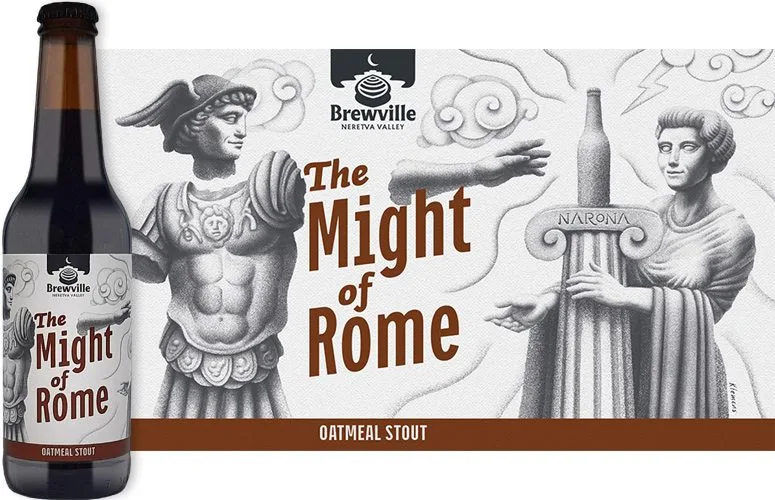
The Might of Rome
Oatmeal Stout
A dark beer brewed with plenty of oats for a soft, creamy mouthfeel. Medium body and low bitterness with notes of coffee, chocolate and caramel.
- Alcohol
- 5,8 %
- Bitterness
- 30 IBU
- Colour
- 78 EBC
Packaging
- 0.33 L bottle (carton of 24)
- 0.33 L bottle (carton of 6)
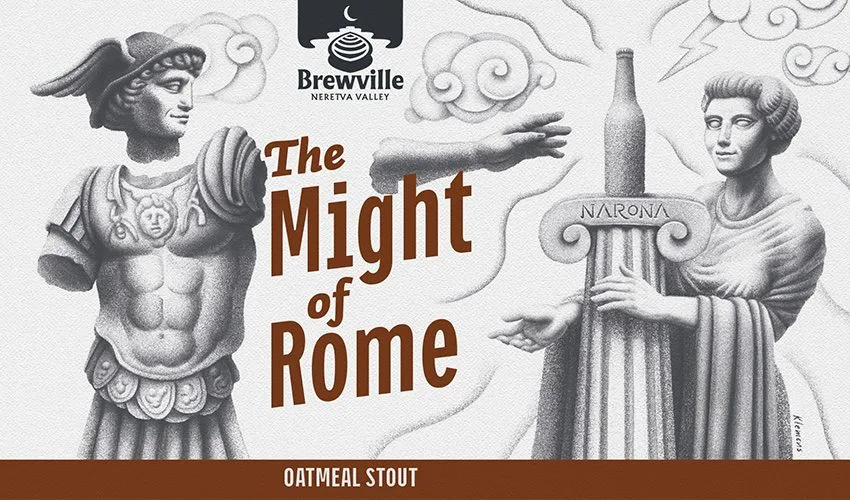
Label · The Might of Rome
The story of ancient Narona
The history of Narona
Narona was a Roman town on the site of today's village of Vid, near Metković. Because its people were loyal to Rome, Narona was more than once the starting point for Roman military campaigns against the rebellious Delmatae. In the 1st century BC the settlement became the Roman colony of Narona and the military, administrative, judicial and cultural centre of the Narona district. Besides trade, building, sculpture and painting flourished. Wealth grew in these surroundings, and luxurious buildings and costly statues were made in Narona. The town probably covered some 25 hectares, which takes in a good part of today's marshland. Many pagan and Eastern deities were worshipped in Narona: Jupiter, Aesculapius, Mercury, Mars, Fortuna, Diana, Ceres, Neptune, Mithras, Liber and the goddess Isis.
Narona's decline is linked to the collapse of the Western Roman Empire, when the town lost its importance and most of its people went to make a living elsewhere. As Christianity grew stronger, Christians often destroyed pagan buildings and symbols, and over the following centuries the unprotected town was frequently plundered.
Narona and the Roman Empire
In the early days of Roman rule Narona was a community of Roman citizens and a municipium. It became a Roman colony, and so gained full Roman citizenship, probably in the time of Caesar in the 1st century BC. A square (the forum) with public buildings and a temple was built in the centre of the town, while the amphitheatre was probably outside it. In the 5th and 6th centuries Narona became the seat of a bishopric and had at least three early Christian churches.
Archaeological research
The first known excavations at Narona took place in 1877, while systematic research began in the late 19th and early 20th centuries and continues to this day. Over that time the forum, the town walls and the roads to Narona have been identified, and many inscriptions, coins, milestones, amphorae and other finds have come to light.
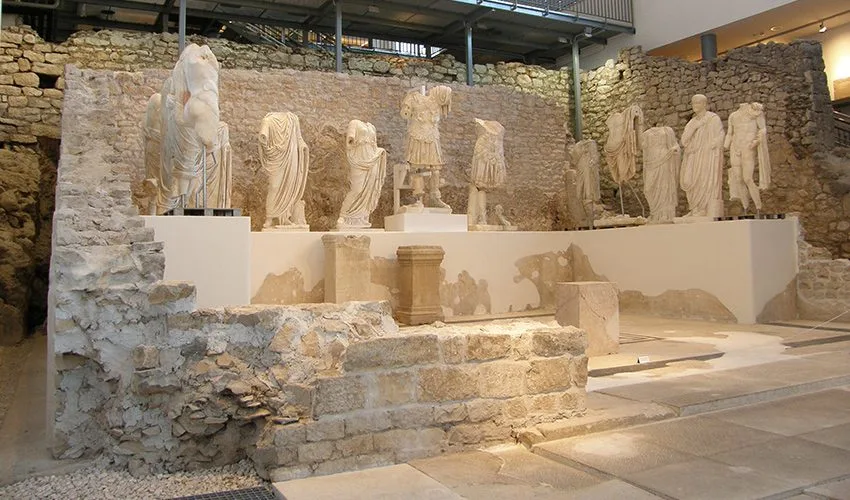
In the centre of Vid, next to the forum, a mosaic was discovered, the defensive walls were investigated and a basilica was partly excavated. In 1978 the head of the emperor Vespasian was found. Between 1991 and 1997 the foundations of a basilica beneath the Church of St Vitus were explored, and a well-preserved baptismal font painted with the rivers of Paradise was uncovered, but it had to be buried again because the ground floods. At least 19 statues were dug up on the forum – 16 of them temple statues of the emperor Augustus and his family and of other Roman dignitaries and deities – all of them headless. A temple (the Augusteum) is thought to have been built on this spot in the 1st century, but in the 4th century, when Christianity became the official religion of the Empire, it was torn down and the headless statues were thrown from their pedestals. Two of the heads, of the god Mercury and the empress Livia, were taken to the Ashmolean Museum in Oxford.
Altogether more than three hundred Roman monuments – ceremonial, public, private and funerary – have been found at Narona, along with a good number of coins, from Roman Republican issues to gold, silver and copper coins of almost every emperor.
The Narona Archaeological Museum
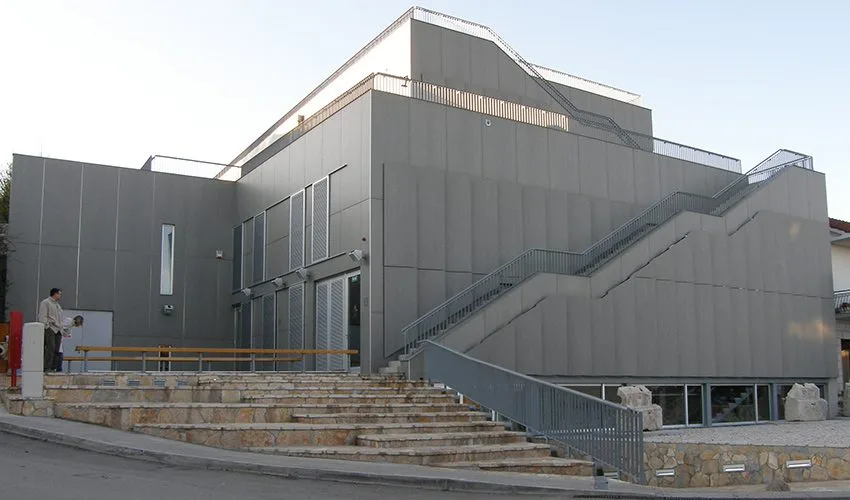
In 1995 and 1996 excavations at the Plečašove štale site led to the sensational discovery of the remains of a Roman temple – the Augusteum – and 17 marble sculptures, life-size and larger than life. This find inspired the idea of presenting this unique archaeological site as a whole, with both its architectural remains and its many other archaeological finds.
After extremely complex construction work, the Narona Archaeological Museum was officially opened on 18 May 2007 as the first museum in Croatia built in situ. Presenting an archaeological site in this way has enriched what Croatia's museums have to offer and has few parallels in Europe or the wider world.
#narona#rim#forum#amfiteatar#vespazijan#augusteum#markur#livija#arheoloski_muzej#dolina#neretva#metkovic#brewville#the_might_of_rome#neretva_valley#craft_beer#craft_brewery